
Prefer to listen?
15 minutes
The Space Between Adequate and Thriving
There's a gap most of us don't know we're living inside.
The recommended daily protein intake — 0.84 grams per kilogram of body weight — was designed to prevent clinical deficiency. For a 70-kilogram person, that's about 59 grams a day. Enough to keep you from falling apart. Not enough to keep you thriving.
That gap — between adequate and optimal — doesn't announce itself. It shows up slowly. In muscle that quietly disappears. In bones that thin without a whisper. In energy that dims so gradually we mistake the fading for ageing itself.
If you're active, if you're over forty, if you're a woman navigating perimenopause or beyond, the research points to a different number entirely: somewhere between 1.0 and 1.6 grams per kilogram for most people, with targets varying by your training intensity, life stage, and goals.
And here's the part that surprises people: you don't need meat to get there. Not even close.

The Conversation We Owe Women
I want to speak directly to women here, because this is where the protein story becomes genuinely overdue.
As we age, the body becomes more anabolically resistant. A technical way of saying: the older you get, the harder your body has to work to turn dietary protein into actual muscle tissue. After menopause, when oestrogen — one of the key signals for muscle protein synthesis — drops away, you need more protein at exactly the stage of life when most women are eating less.
For decades, nutritional science studied male subjects and extrapolated the results to everyone. Dr Stacy Sims, an exercise physiologist based here in New Zealand, has spent her career dismantling that assumption. Advice like "fast more, eat less, train fasted in the morning" works reasonably well for male physiology.
For women, it can quietly undermine hormonal balance, thyroid function, and bone density. The female hypothalamus is exquisitely sensitive to energy availability. Chronic caloric restriction layered on hard training can disrupt everything from cortisol to menstrual cycles. Context is everything. And the context most women have been given is wrong.

The Silent Emergency Beneath Your Feet
Now let's talk about bones. This is the one nobody feels happening until it's too late.
One in three women over fifty will experience an osteoporotic fracture. The window for meaningful intervention is perimenopause — the years right before menstruation ends — when bone loss is fastest and most responsive to what we do about it.
The non-negotiables: weight-bearing exercise. Adequate protein. Vitamin K, magnesium, and calcium working together.
And something that inspired my yoga practice — in a 2015 study authors concluded that a selected 12-minutes of Iyengar yoga daily was a safe and effective way to reverse bone loss and increase bone mineral density in the spine and femur. Those looking to use Yoga for bone health should aim for longer holds in stronger poses, and include those fun hops from pose to pose, so the benefits of both resistance and impact are harnessed.
We've been doing daily yoga at Aro Ha for fourteen years. Sometimes the body of evidence catches up with the body of practice.

Building and Clearing — The Art of Balancing
Here's where it gets nuanced. And where most wellness advice falls apart.
Fasting — done right, at the right time, for the right person — is one of the most powerful longevity tools we have. Reduce caloric intake strategically and something remarkable happens at the cellular level. Old, damaged proteins get broken down and recycled. Mitochondria get cleaned up. Growth hormone rises. Inflammation drops. That process is called autophagy, and it's genuinely profound.
But autophagy and muscle protein synthesis are, in some ways, opposing signals. One says break down and recycle. The other says build and repair.
Both are essential. The art is knowing which one your body needs right now.
Someone with robust muscle mass and solid metabolic health? Strategic fasting can unlock cellular renewal. Someone navigating osteoporosis or significant muscle loss? Consistent, protein-rich nourishment is the medicine. Not restriction. Someone on a GLP-1 medication — where appetite is already suppressed and muscle loss is a real risk — may need that consistent nourishment even more than most.
There's a clinical word for what happens when muscle loss crosses a threshold — sarcopenia. It means your body has less capacity to recover, to balance, to absorb the ordinary shocks of living. If that's where you are, building isn't optional. It's the priority.
This might be the question for anyone over forty: Am I in a season of focused building — or one where building and clearing need to work in balance?
Get that wrong, and the best protocol in the world works against you.
What Fourteen Years Have Taught Us
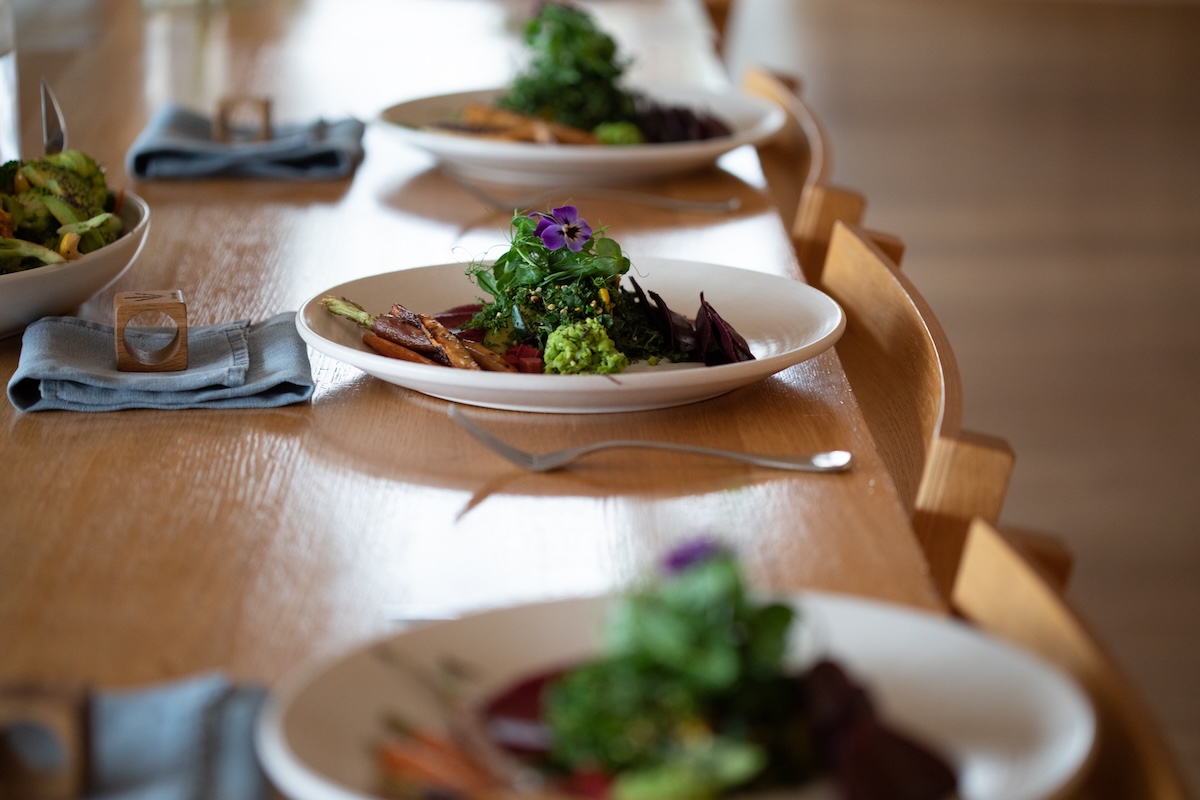
At Aro Ha, we've fed guests an entirely plant-based menu while guiding them through some of the most physically demanding weeks of their lives for over a decade. Alpine hiking. Strength training. Yoga. Pilates. Supported recovery and deep rest. No phones.
We've watched thousands of people arrive worried about protein — and leave with measurably improved body composition, reversed biological markers, and a relationship with food that actually serves them.
What we've done recently is get more precise. Our own fasting protocol — plant-based, calorie-restricted, designed for cellular renewal — is powerful medicine for the right person. But it's low-protein by design. Which is exactly why we now orient every guest into one of three tracks:
The Resetter — you're here for the full cellular reset. The longevity science. The autophagy. Your body is ready to clear the backlog.
The Balancer — you're here to feel human again. Reconnect. Sleep. Move. Breathe. You don't need optimisation. You need more restorative space.
The Rebuilder — you're in a phase of life where preserving muscle and bone is the priority. Higher protein all week. Fasting swapped for consistent nourishment. Same movement, same nature, same magic. Different fuel strategy.
This choice has always existed, but we've made it more implicit. Same mountains. Same community. Same transformation. We've just learned to meet people where they actually are.
One Thing Tomorrow Morning
If you notice you're fairly carb heavy with your breakfasts, you don't need to track every gram. You don't need to optimise every meal. You don't need to know your ketone-glucose index before breakfast.
But tomorrow morning, let your breakfast centre around whole foods, and roughly thirty grams of protein. That's it. That's the one change that shifts things downstream. Because most of us start the day with almost none — and spend the rest of it trying to catch up.
Beyond that? Mostly plants. Movement that loads your bones and challenges your muscles. Sleep. Some space from the noise.
Do those things — consistently, in a life you actually want to live — and the body knows what to do.
It's not broken. It's just waiting for the right conditions.
Give it those — and watch what happens.
May you Thrive On — today and every day.
Find more Thrive On episodes: YouTube, Spotify, Apple Podcasts
You may also like to try '5 to Thrive' - 5 breakfast recipes over 5 days to transform your mornings. Access for free here.