
Time in nature is often prescribed as a simple remedy. Yet, it’s not uncommon to arrive in extraordinary landscapes only to find our mind is still elsewhere. Despite taking the time to escape, the brain is still cycling through decisions, conversations, and unfinished tasks.
In this case, the environment changes, yet the mental state remains in overdrive, taking us away physically, but not lessening the cognitive load.
The Attention Economy Within the Mind
Research from Harvard University suggests that the human mind wanders nearly half of the time, often toward self-referential thought. This activity is associated with the brain’s default mode network (DMN)—a system linked to reflection. While DMN is important and valuable, when overactive and over-stimulated, it can lead to rumination and mental fatigue.
This commonly looks like:
- Replaying past interactions
- Anticipating future outcomes
- Maintaining an ongoing internal narrative
Even in moments designed for rest, this mental loop persists, overlaying internal noise onto external stillness.

Soft Fascination: Nature’s Antidote to Mental Fatigue
Psychologists studying Attention Restoration Theory (ART) have identified a unique property of natural environments known as soft fascination.
Research from the University of Michigan and University of Utah shows that when we are present and aware, nature gently captures attention without effort—through movement, texture, and subtle variation:
- Light shifting across water
- The rhythm of footsteps on a trail
- Wind moving through alpine trees
Unlike digital stimuli, which demands and fragments attention, these experiences hold it softly.
This allows the brain’s directed attention system to rest and recover—while simultaneously quieting the overactivity of the default mode network.
The result is a state of calm alertness: present, aware, and cognitively restored.
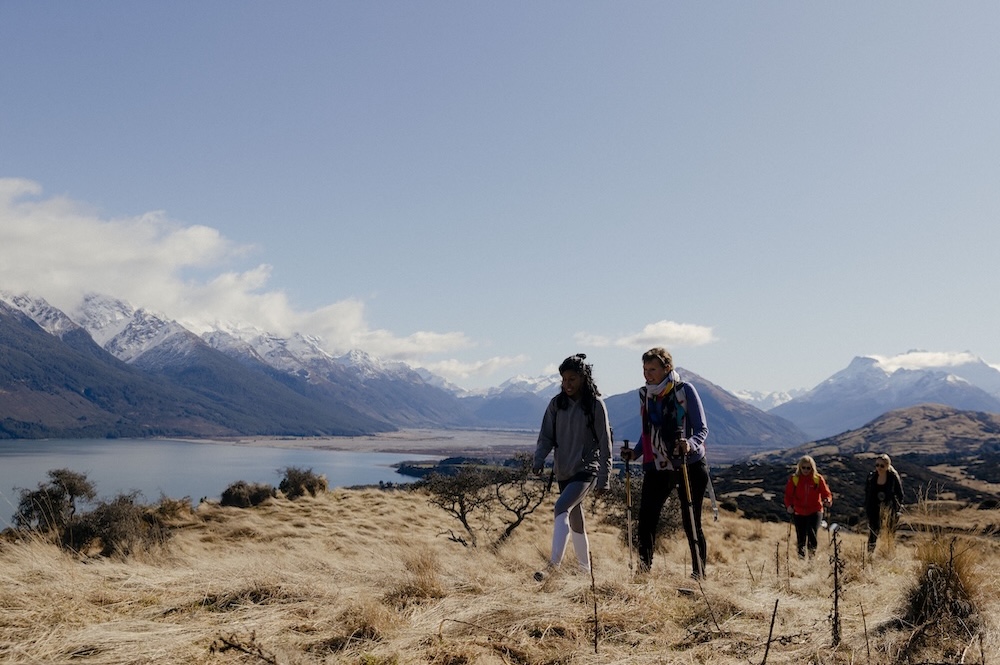
Hiking as a Cognitive Reset
Hiking in nature enhances this effect.
A landmark study published in Proceedings of the National Academy of Sciences found that participants who walked in natural settings showed reduced rumination and decreased neural activity in brain regions associated with mental distress.
Hiking introduces the essential element of embodiment whereby:
- Attention shifts to breath, movement, and terrain
- The body anchors awareness in the present moment
- Cognitive load is redistributed away from abstract thought
This combination interrupts habitual mental loops and creates space for clarity to emerge.

From Mental Noise to Strategic Clarity
The implications are significant. When attention is restored:
- Decision-making becomes more precise
- Creativity expands beyond habitual thinking
- Emotional reactivity decreases
- Strategic insight deepens
This is not disengagement—it is recalibration.
The ability to focus, prioritise, and make decisions effectively depends on access to this quieter, more coherent mental state.

The Aro Ha Approach: Designing for Presence
At Aro Ha, hiking is not positioned as exercise alone, but as a deliberate practice of attention.
Guided alpine experiences are designed to:
- Shift awareness from internal narrative to external environment
- Engage the senses fully and without distraction
- Create conditions for soft fascination to emerge naturally
Through this process, nature is no longer observed at a distance—it is experienced directly.
This distinction is where restoration begins.
Beyond the Retreat: Integrating Restored Attention
The benefits of nature-based attention restoration extend well beyond the retreat environment.
Sustainable integration may include:
- Regular device-free time in natural settings
- Walking meetings without digital interruption
- Intentional pauses to reset attention throughout the day
These practices reinforce something incredibly important in modern times - the ability to direct attention, rather than be directed by it.
If you're craving some time in nature to clear your mind and recalibrate your system, join us in the beautiful Southern Alps, there is no place quite like it to come home to yourself again.