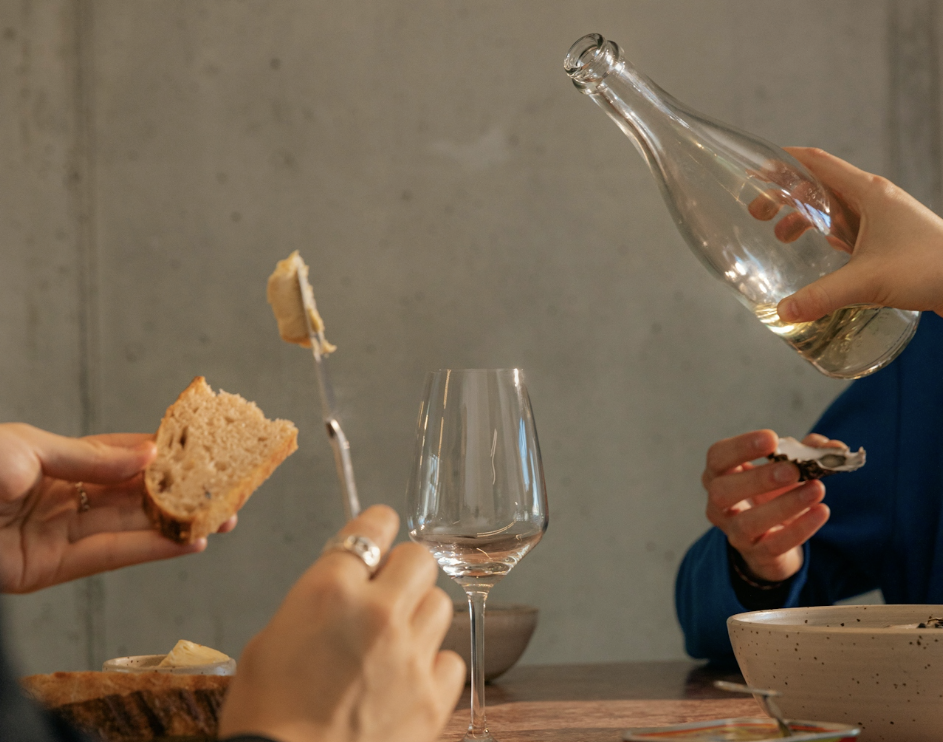
Is a glass of red wine a night good for me?
When I was considering taking a year off drinking, a silent fear was percolating underneath: Will life be bearable?
I'm happy to report that after several years of near abstinence, I don't miss the habit. I don't miss the hangovers, I don't miss the low energy, and life is even more fun because I discovered something that was holding me back.
Let’s checkout the science, plainly. Then let me give you the part that science doesn't cover, which is what actually helps us change.
The short version, if you're in a hurry The famous "one glass a day is good for you" curve was an artefact of who ended up in the comparison group. Alcohol reaches every cell you own, and the harm becomes steep and unarguable somewhere around a drink a day, far below what most of us think of as normal. But your liver keeps a written record, it's legible from a single blood draw, and the good news is damage is often reversible. Knowing your number beats arguing about the population average.
The old story has quietly collapsed
For thirty years it felt like we were told moderate drinking improved health. That was the "French paradox," the resveratrol headlines, and the permission slip I built a dinner ritual around.
Many of those findings weren't fabricated. They were confounded. The abstainer group in those early studies was full of people who had stopped drinking because they were already unwell, the “sick quitters”. When researchers separate lifelong non-drinkers from former drinkers, the protective curve flattens. In 2023 the World Health Organization stated its position without hedging: no level of alcohol consumption is established as safe for health. Alcohol sits in the WHO's Group 1 carcinogen category — the same classification as tobacco, asbestos and ionising radiation.
Dr. Mark Hyman puts it as bluntly as anyone in functional medicine: “the net health benefit is zero.”
Exhibit A: the graph that did the persuading
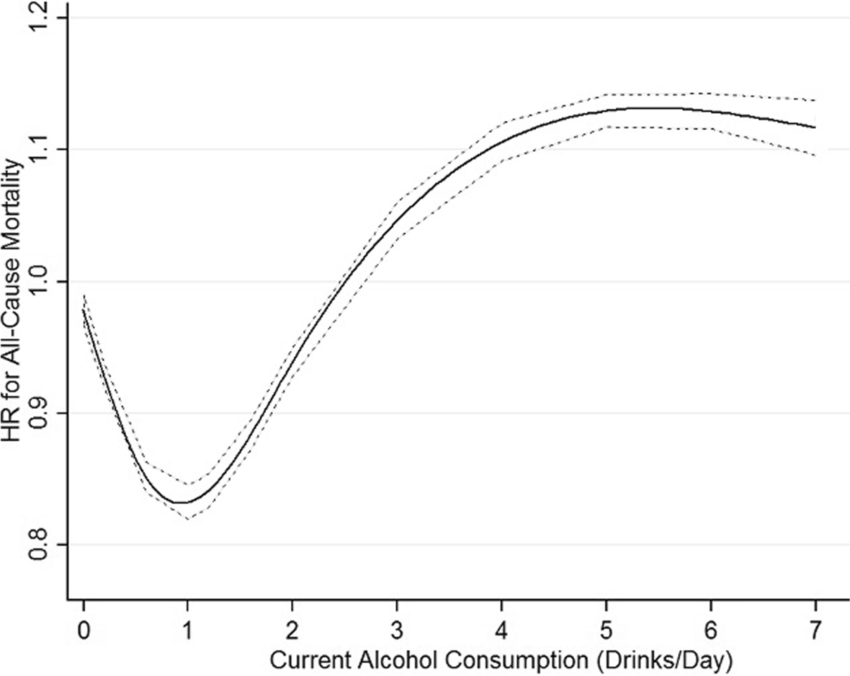
"Alcohol consumption and all-cause and cause-specific mortality among US adults: prospective cohort study." BMC Medicine 2023;21:208, Figure 1.
There it is. The famous J-curve. Look at that little valley at one drink a day, sitting confidently below 1.0, and tell me you wouldn't pour yourself a glass.
I looked at this graph and drew exactly the wrong conclusion from it. Two things I'd point out now.
The dip is about who's assessed at zero. That point at the far left isn't a clean control group. It's lifelong non-drinkers mixed with people who quit — often because a doctor told them it was important for survival. Compare drinkers against a group seeded with the recently unwell and moderate drinkers will look great.
And look where the line goes. Everyone remembers the dip. Almost nobody remembers that the curve is nearly back above 1.0 by two drinks a day and still climbing at four. We took a permission slip from the first inch of a graph and ignored the rest of it.
Did you know that a liver’s ALT score of 19 U/L for women and 30 U/L for men points toward possible fatty liver?
Take a test form home:
Try Longevity Labs
Exhibit B: the graph nobody put on a poster
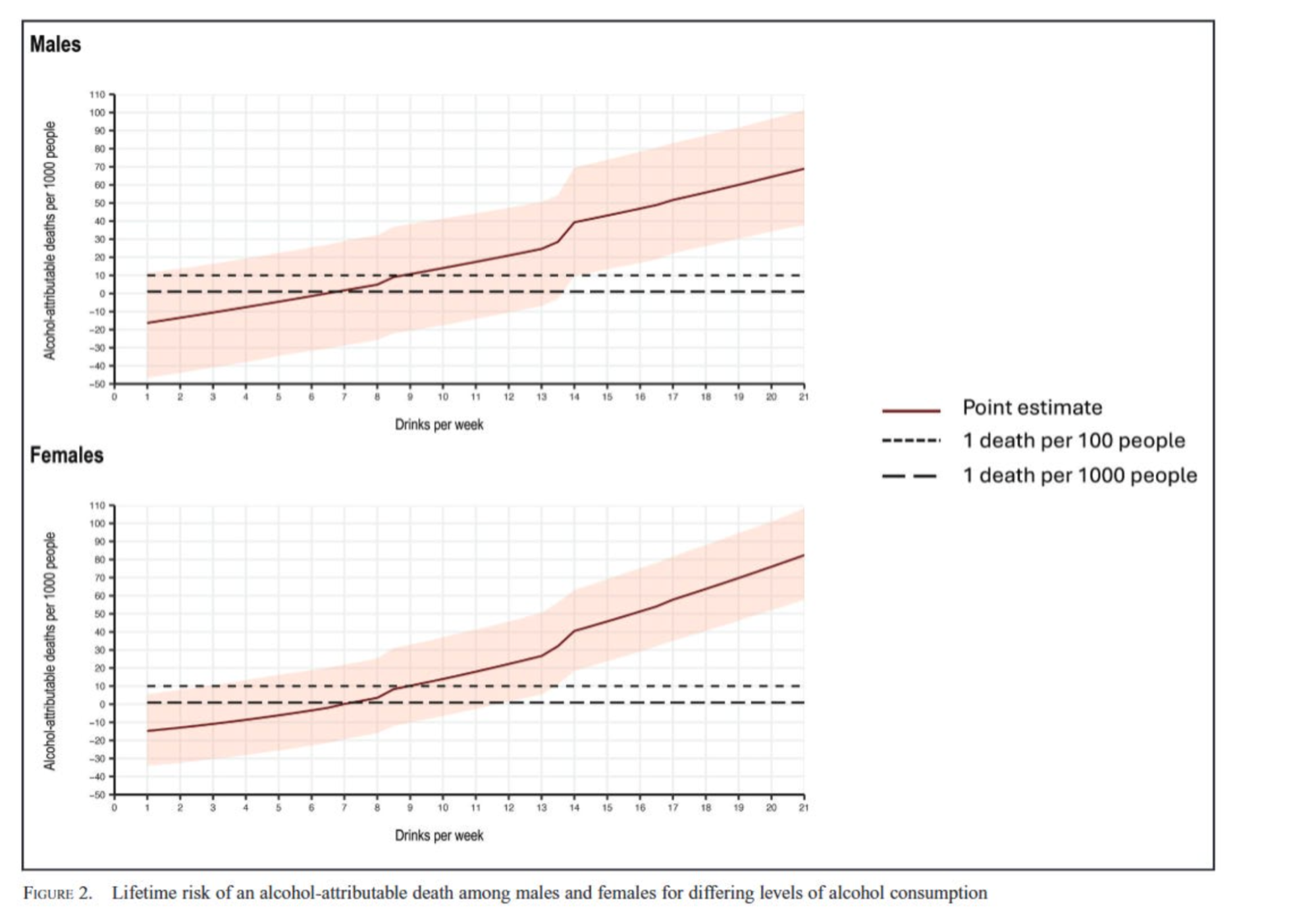
“Alcohol Intake and Health Study: No Protective Effect at Low Levels, With Mortality Increasing to 1 in 25 at 14 Drinks Per Week." Journal of Studies on Alcohol and Drugs 2026;87(4):621–638
Same subject, different question, and this is the one we should post on the liquor store window.
Exhibit A asked how does my risk compare to someone else's? That's a relative number, and relative numbers are slippery. Exhibit B asks out of people drinking like me, how many die of it? That's an absolute number, and absolute numbers are more honest.
Two panels, men on top, women below. The y-axis counts alcohol-attributable deaths per 1,000 people over a lifetime. The two dashed lines are the thresholds public health people actually use: one death per 1,000, and one death per 100.
First, lets translate the x-axis
Nobody drinks in "drinks." And this is American data, which makes it worse — a US drink is 14 grams of alcohol and New Zealands is 10, so every number along that bottom axis is bigger than it looks to a New Zealander.
A restaurant pour of red is about 150ml, which at 13% is roughly a drink and a half of NZ measure. The glass you actually pour yourself at home is nearer 250ml — that's two and a half. A bottle is a shade under eight.

Now go back and look at the graph knowing that.
Reading the curve
The flat bit at the start. Out to about six drinks a week the line sits near or below zero, and the shaded interval is enormous. That's the honest part of the picture: at low intake the modelling genuinely cannot separate you from someone who doesn't drink at all.
One in a thousand. The line crosses the lower dashed threshold at 6.5 drinks a week for men and 7 for women. That's around ten of our standard drinks — a bottle and a bit, or four decent glasses.
One in a hundred. At 8.5 drinks a week, both sexes cross the upper line. Call it under five glasses of wine a week. Not five a night. Five across the whole week. That's was my old Friday night, and it carries a one percent lifetime chance of dying from it.
The elbow. Look at where the line kinks upward — right around 14 drinks a week. Both panels do it. That's two and a half bottles, or two drinks a day. At that intake a man's lifetime risk is about 1 in 25. Four percent.
The top end. At 21 drinks a week — three drinks a day, roughly 11 big glasses or nearly four bottles — seven or eight percent of people are dying from drinking.
Now hold all of that against New Zealand's own low-risk advice: 10 standard drinks a week for women, 15 for men. Ten converts to about 7 American drinks — already past the one-in-a-thousand mark. Fifteen converts to about 10.7 — comfortably past one in a hundred. Our official ceiling for men, the number a GP might reassure you with, is still risky.
And now the part I'd want every woman to see
Put the two panels side by side and they look like the same graph. They aren't.
Up to about 14 drinks a week the two curves track each other closely. After the elbow they separate, and the women's curve climbs faster. At 21 drinks a week a woman's lifetime risk of an alcohol-attributable death is roughly 8.2%, against 6.9% for a man — about a fifth higher at the identical weekly intake.
Same glass. Same week. More harm.
Breast cancer risk rises with alcohol from very low intakes. And in this same study, at 14 drinks a week women were already more than twice as likely as men to die of cirrhosis and other chronic liver disease.
If you're a woman who has ever quietly matched a partner glass for glass and assumed you were being sensible because he seemed fine, this graph is the reason that never felt fair.
Here is a highlight, were you might choose to hangout, and it’s fair to the data. That shaded band matters. It is the statistician's way of saying we honestly cannot tell one or two drinks a week apart from none. Reasonable researchers still argue about that inch of the graph. What nobody argues about is the middle and the right of it, where the line stops being ambiguous and starts being a slope.
Worth noting too: this team went looking for the protective dip from Exhibit A, and didn't find it at any level.
So the useful question isn't "is wine good for me." It's "what is this molecule actually doing, and is it worth it for me?”
Why alcohol reaches everywhere
Dr. Andrew Huberman makes a point that reframed this for me entirely. Ethanol is one of very few molecules that is both water-soluble and fat-soluble. It crosses cell membranes without a passport. It doesn't act on one organ — it passes into essentially every cell and tissue you have.
Here's the cascade, in the order your body experiences it.
Your brain, in the first hour. Alcohol boosts GABA (your calming neurotransmitter) and suppresses glutamate (your excitatory one). That's the loosening, the ease, the shoulders dropping. Dopamine and endorphins join in. This is real relief, and pretending otherwise is why so much of the alcohol conversation feels lopsided.
Your brain, the next morning. As it clears, the pendulum swings hard the other way — GABA drops, glutamate spikes. Dr. Sarah de la Torre calls the result "hangxiety," and she is emphatic that it is not psychological guilt. It's a metabolic, microbial and neurochemical event: alcohol also kills off gut bacteria involved in serotonin production and increases intestinal permeability while you sleep it off.
Your brain, over years. This is the finding that gets people's attention. Huberman's reading of the imaging literature is that even one to two drinks a day produces measurable thinning of the prefrontal cortex — the region governing planning, impulse control and emotional regulation. The largest study behind that, a UK Biobank analysis of some 36,000 people, found grey and white matter reductions that scaled with every additional daily drink.
Then there's the thirty-year one. Oxford researchers followed 550 British adults from their forties into old age, scanning them at the end. Drinkers at 14 to 21 UK units a week — that's roughly 11 to 17 New Zealand standard drinks, which is to say right on top of our own official guideline — had around three times the odds of atrophy in the right hippocampus, your memory and spatial navigation centre. Below seven units a week they found no increased odds. They also found no protective effect down there. Nothing to be gained, just nothing yet lost.
And because it's the prefrontal cortex being eroded, habitual drinkers often become more impulsive while sober. The tool you reach for to manage yourself slowly degrades your capacity to manage yourself.
Your stress system. Alcohol suppresses stress in the moment and then raises your baseline cortisol when you're not drinking. You feel more anxious on a Tuesday afternoon, so you reach for the thing that takes the edge off, which raises the baseline again. That's not weakness. That's a closed loop.
Your liver. Your body doesn't classify ethanol as a nutrient. It classifies it as a toxin, and drops everything — blood sugar regulation, fat metabolism — to clear it. The pathway runs ethanol → acetaldehyde → acetate. Acetaldehyde is the villain: highly reactive, strongly oxidative, and implicated in the DNA damage behind alcohol's cancer risk. Your liver clears roughly one standard drink per hour. Drink faster and acetaldehyde pools.
Your body composition. Alcohol directly inhibits muscle protein synthesis, so your training returns less than it should. It accelerates aromatisation — testosterone converting to estrogen — in both men and women. And by forcing the liver to prioritise ethanol over glucose regulation, it reduces insulin sensitivity. This could be part of the answer to why your training is going well but your midsection isn't.
Your sleep. Alcohol is a sedative, not a sleep aid. Sedation removes consciousness; it does not deliver sleep architecture. REM is suppressed, deep sleep is fragmented — and those are precisely the stages where memory consolidates, hormones reset and cells repair. Dr. Somi Javaid adds the part nobody over forty wants to hear: as we age the liver metabolises alcohol less efficiently, so it lingers longer and wrecks more sleep than the same two glasses did at twenty-five.
Ask your liver
Your liver keeps the score of your drinking — and you can easily find out how it's doing.
Up to a third of adults are walking around with non-alcoholic or alcohol-related fatty liver and no symptoms whatsoever. The best news is that it's one of the more reversible conditions in medicine — if, you know it's there.
I just learned this… Your lab report will call an ALT of 35 "normal" — but those reference ranges were built from general populations that included plenty of people with undiagnosed fatty liver. When researchers stripped those people out and asked what a genuinely healthy liver looks like, the numbers came back much lower: around 19 U/L for women and 30 U/L for men in the landmark analysis, with professional bodies now proposing similar ranges.
So a result of 32 can be simultaneously "normal" on your printout and worth a closer look. To be straight with you: ALT alone doesn't diagnose anything — fatty liver is confirmed on imaging, and it can hide behind a perfectly normal ALT. What a number like that gives you is a flag, and a baseline. Which is exactly what you want, because a flag is actionable and a vague feeling isn't.
Ever wonder, "how is my drinking showing up in my body?" This is exactly why we built Longevity Labs: high-quality diagnostic testing, targeted, and delivered. Our Liver Function Check measures seven markers from a single at-home blood draw.
This is where our efforts to be healthy can become guided.
Test → observe → create change → test again.
An ALT of 32 today becomes the number you watch fall toward 20 — and watching it fall is a far better motivator than anything I could say here.
Information isn't the bottleneck. State is.
Now the part I actually know something about, after fourteen years and more than eight thousand guests.
Nobody drinks heavily because they're unaware alcohol is harmful. Reaching for a drink is rarely a failure of willpower. It's a nervous system trying to soothe discomfort using a familiar friend that has helped before.
Which means the intervention isn't more facts. It's clarity around a better way to manage lifes hardships. Imagine knowing clearly how to feel great, how grow from your emotions, and how to live the life you deserve. If the part of you that needs a drink, genuinely believed it had an even better option, wouldn’t it take that option? That's the whole architecture of what we do at Aro Ha. We ground you practices that stack functions, and support change. You take the toolkit home as a verified felt experience.
You arrive in the Southern Alps. Screens go away. The sleep window opens, unpolluted by blue light — melatonin secretes as designed, and the glymphatic system gets a proper run at clearing the day's metabolic waste. Alpine hiking through beech forest exposes you to phytoncides, which appear to elevate natural killer cell activity for weeks afterward in the forest-bathing research, though those studies are small. Whole foods, plant-based and fibre-dense — around 70g a day — which begins repairing the exact gut barrier alcohol had been eroding.
Then there is space and insight to help replace the tool. This is the heart of it: your nervous system may need downregulation, and once it finds relief of a much deeper nature, it has found something better than alcohol to soothe with. So we offer you things that do the job without the acetaldehyde:
- Contrast therapy — sauna and cold plunge. Huberman cites sustained norepinephrine and dopamine increases in the 200–300% range, depending on how cold and how long. It is genuinely the closest legitimate substitute for what people are chasing at 6pm, and it leaves you sharper rather than duller.
- Extended exhale and heart coherence breathing — five to six breaths a minute engages the vagal brake. Physiological calm, thirty seconds, no cost.
- Yin and yoga nidra — yoga practice has been shown to raise GABA through parasympathetic activation. That's the same neurotransmitter alcohol was borrowing against, accessed without the rebound.
- Our IFS-inspired inner work — the part that goes underneath the habit. Internal Family Systems lets you meet the part of you that reaches for the glass with curiosity instead of contempt. In my experience this is the difference between white-knuckling January and never really wanting it again.
- Time in silence, and threshold ritual. Ritual isn't decoration. It creates a clean cognitive marker — a before and an after — and that marker is what habit change hangs on.
Most guests haven't had a drink for seven days by the time they leave, and nearly everyone experiences it as relief. Sometimes it's like discovering what they've been numbing from. That's the break state. The world around us doesn't need to change — we can change. What you do with that afterwards is up to you.
So what do I tell people?
I’d never tell you not to drink again. These days I drink two or three times a year. I'm not an abstinence evangelist, and moralising about wine has never changed a single behaviour I've witnessed.
What I'll say is this. The old story that alcohol was protecting your heart is gone. What's left is a molecule that goes everywhere, degrades the very part of your brain you use to make good decisions, and steals the sleep in which you'd otherwise repair.
But you're extraordinarily resilient. From my experience it took about two months to really feel a new habit forming, and about six months to stop thinking about it. The six months will pass either way. In that time the gut lining heals, sleep regulates, brain chemistry recalibrates — faster than you'd think.
So: get the bloodwork. Take a real break, in a place that makes the break easy. Retest. Then decide from data and from felt experience, rather than from habit or from guilt.
Those are much better foundations than either.
Common questions
How many drinks a week is actually "too much" in New Zealand? Our official low-risk advice is no more than 10 standard drinks a week for women and 15 for men, with at least two alcohol-free days every week. Two things worth knowing.
First — and this is where almost everyone is out by half — a standard drink here is 10g of pure alcohol. That's smaller than the thing in your hand:
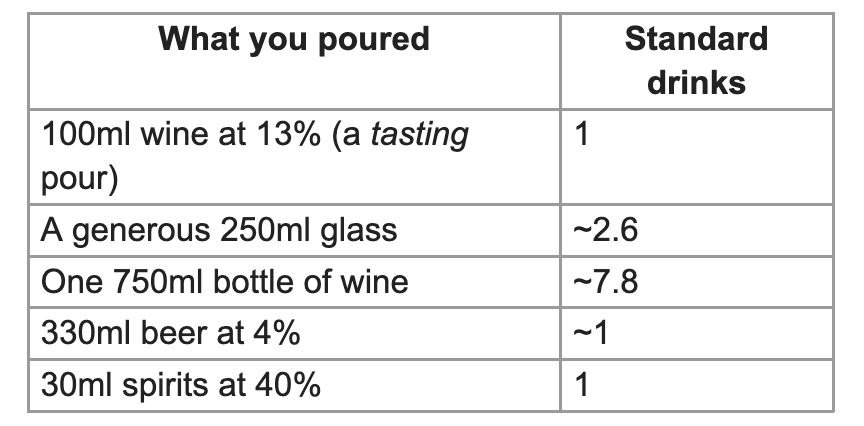
So "two glasses with dinner" is often five standard drinks, and a shared bottle on Friday plus another on Sunday is most of a woman's weekly allowance. Second: the guidance says explicitly that low-risk is not no-risk — and as Exhibit B above shows, the upper end of that official advice already sits near a one-in-a-hundred lifetime risk.
Is alcohol a drug? Yes — a central nervous system depressant, and an addictive one. It reads as stimulating early on only because the first thing it depresses is your inhibition. The sedation was always there; you just met the disinhibition first.
Alcohol vs. weed — which is worse for you? Different risk profiles, and honestly not a comparison I'd build a decision on. Alcohol has the stronger evidence base for organ damage, carcinogenicity and physical dependence, including a withdrawal syndrome that can be fatal. Cannabis carries its own concerns — cognitive effects in developing brains, dependence, and the fact that smoking anything irritates lung tissue. "Less bad than alcohol" is a low bar to clear, and not the same as good.
Is tolerance for alcohol genetic? Partly. Family history is one of the strongest predictors of alcohol use disorder, and variants in the ALDH2 and ADH1B genes substantially change how fast you convert acetaldehyde — which is why some people flush and feel awful after one drink. Our DNA Comprehensive Check covers liver phase I/II detoxification pathways, and MTHFR testing speaks to the methylation capacity that alcohol depletes. Genes load the gun; they don't fire it.
Why does alcohol raise my blood pressure? Several mechanisms stack: sympathetic nervous system activation, increased vascular stiffness, disrupted baroreflex sensitivity, and the elevated baseline cortisol described above. It's one of the more responsive markers, too — many people see meaningful drops within weeks of stopping.
Can I offset drinking with exercise and clean eating? Partially, not completely. Fitness genuinely buffers cardiovascular and metabolic risk. It does not neutralise acetaldehyde's DNA damage, and the carcinogenic risk appears largely independent of how fit you are. Worth knowing too: alcohol inhibits muscle protein synthesis, so the drinking is also taxing the training you'd be using to offset it.
Do liver detoxes and cleanses work? Your liver is the detox organ; it doesn't need a juice to do its job. What it responds to is having the load removed — abstinence, sleep, fibre, adequate protein, hydration, and the methylation cofactors (B12, folate, magnesium) it needs for phase II conjugation. That's the whole protocol. Anything sold as a "liver flush" is selling you the absence of alcohol at a markup.
Are non-alcoholic spirits and kava good substitutes? For the ritual, absolutely — and the ritual is often most of what people actually miss. Zero-proof options let you keep the glass, the ceremony and the social ease without the ethanol. Kava is genuinely psychoactive rather than a placebo, which means it deserves respect: there have been case reports of liver injury, so it isn't a free swap, and it's worth discussing with a doctor if you take other medications. My honest view is that cold water and slow breathing do the same job with a better safety profile and a much better morning.
How long until my bloodwork actually changes? Faster than most people expect. GGT has a half-life of roughly two to three weeks and often moves visibly within a month. ALT follows. Fatty liver — the thing to actually care about — commonly improves substantially over three to six months. Ninety days is the sweet spot for a meaningful retest.
Curious what alcohol has actually cost you? Explore panels at Longevity Labs, or come break state with us in the Southern Alps at aro-ha.com.
This article is educational and not medical advice. Alcohol withdrawal can be medically dangerous — if you're a heavy daily drinker, please don't stop abruptly without speaking to a doctor first.